
Internet of Things in Smart Homes
The smart home is no longer just a collection of connected devices. It is becoming an integrated IoT ecosystem where lighting, heating, security, and appliances work together. Standards such as Matter improve interoperability, while AI-powered assistants make device control more intuitive and adaptive.
This integration also supports smarter energy management, allowing homes to adjust consumption to user behavior and changing conditions. This article explains how IoT-based home automation works and explores the technologies, standards, AI tools, and energy optimization methods shaping modern smart homes.
Key IoT Home Automation Use Cases
Before looking at how IoT systems work on a technical level, it is important to understand what real problems they solve in everyday life. Most people experience IoT not as a set of technologies, but as practical and easy-to-understand scenarios: from automated lighting to remote security monitoring. These use cases illustrate the practical value that connected-home systems can provide.

Lighting That Adapts to Conditions and Habits
Smart lighting removes the need for constant manual control. The system can turn lights on or off depending on occupancy, time of day, or available natural light. As a result, the home adapts to the daily routines of its occupants, while electricity consumption is reduced without any extra effort from the user.
Climate Control Without Constant Adjustments
IoT systems make temperature and indoor climate management more predictable and convenient. Heating and air conditioning can maintain comfortable conditions automatically, taking into account schedules, occupancy, and external factors. Users no longer need to adjust settings throughout the day, because the system handles this on its own.
Home Security and Fast Response to Events
One of the most common IoT use cases is home security. Smart cameras, locks, and sensors allow homeowners to monitor what is happening inside and around the house in real time. When unusual activity is detected, the system sends a notification so homeowners can take action right away, even when they are away from home.
Smarter Energy Usage
Smart home IoT devices can track energy consumption, reduce unnecessary usage, and help connected systems operate more efficiently. Energy management is an important part of home automation, and we will look at it in more detail later in the article.
Remote Home Management
Remote access remains one of the key benefits of smart homes. The ability to check device status, change settings, or receive alerts from anywhere makes home management more flexible and reliable. This scenario is particularly relevant for frequent travelers and for those who manage multiple properties.
Water Leak Detection and Home Safety
IoT sensors can detect water leaks, unusual moisture levels, or other signs of potential damage before the problem becomes serious. Connected systems can immediately alert homeowners and, in some cases, automatically shut off the water supply, helping reduce property damage and improve overall home safety.
How a Smart Home IoT System Works
A smart home system connects devices through local networks and, where needed, gateways or Thread Border Routers. Automation logic is executed by a controller, hub, device, or cloud service depending on the architecture.
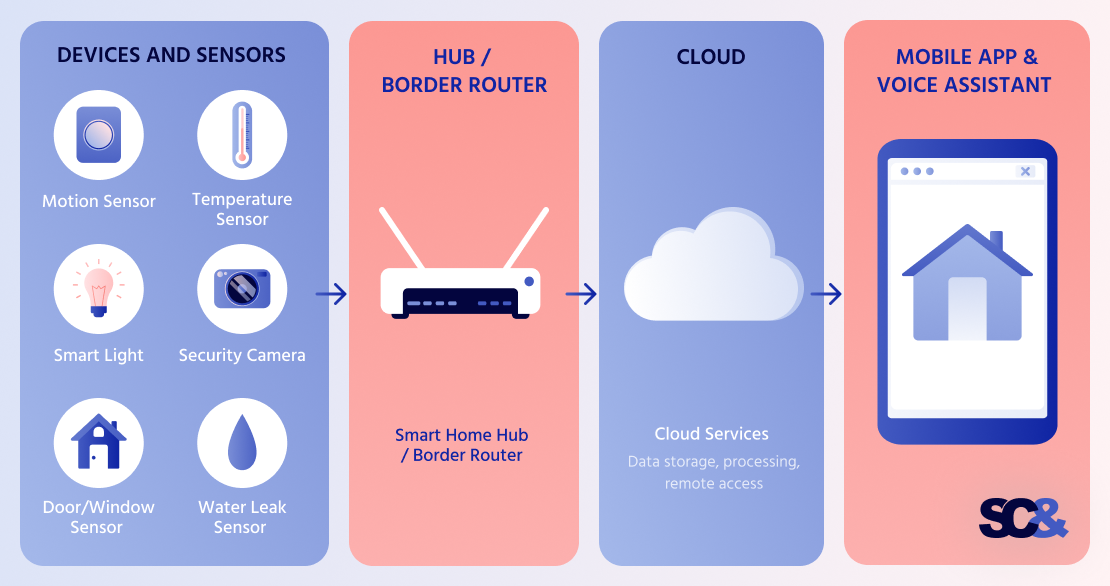
In an IoT-based smart home, sensors continuously collect information about motion, temperature, humidity, lighting, device status, and other conditions. The system uses this data to coordinate connected devices, automate routines, and reduce the need for constant manual control.
From Sensors to Actions
Automation starts with an event. When someone enters the home, presence sensors can activate lights, adjust the temperature, and launch familiar routines. When the home is empty, the system can turn off unnecessary lighting, reduce heating or cooling, and limit energy use.
Safety events trigger a different response. Smoke, gas, water leaks, unexpected movement, or unusual door activity can generate alerts and activate predefined actions, such as sounding an alarm, recording video, or shutting off a connected water valve.
Local vs Cloud Control
Some automation can run locally through a smart home hub or border router, allowing devices to respond even when the internet connection is unavailable. Local processing can also reduce latency and keep more household data inside the home.
Cloud services add remote processing, synchronization, data analysis, and integration with external platforms. Many modern systems combine both approaches, using local control for essential automations and cloud services for features that depend on internet connectivity.
Remote Access and Monitoring
Mobile apps and voice assistants give homeowners access to connected devices from almost anywhere. Users can check system status, receive notifications, adjust settings, view cameras, or activate devices remotely.
This combination of sensors, automation, local processing, cloud services, and remote access turns separate smart devices into a coordinated system that can respond to everyday events with minimal user input.
Matter Smart Home and Other Smart Home Protocols
A Matter smart home relies on standardized communication between devices, while other smart home protocols handle different networking needs. Matter does not replace Wi-Fi, Thread, or Ethernet. Instead, it works as an application-layer standard that allows compatible devices and platforms to communicate using common rules.
Matter is developed by the Connectivity Standards Alliance (CSA) with participation from major technology and device manufacturers. One of its key features is Multi-Admin, which allows the same Matter device to be shared across multiple compatible platforms instead of being locked into a single ecosystem.
As of September 2026, the current specification is Matter 1.6. Matter 1.5 introduced support for cameras and video doorbells and expanded energy-management capabilities, including standardized information related to electricity pricing, tariffs, and grid carbon intensity.
Matter 1.6 focuses more on usability than new device categories. It improves commissioning, multi-ecosystem device management, contextual controls, and the way devices communicate their capabilities and operating states. These updates continue the broader effort to make devices easier to configure and use across different platforms.
Matter commonly operates over Wi-Fi, Ethernet, or Thread, while Bluetooth Low Energy is primarily used during device setup. Thread is particularly useful for battery-powered sensors because it creates a low-power mesh network, although Thread-based Matter devices normally require access to a compatible border router.
Older protocols remain widely used. Zigbee and Z-Wave provide low-power mesh networking and typically rely on compatible hubs. Wi-Fi offers higher bandwidth and direct IP connectivity, while BLE works well for short-range communication and commissioning.
| Protocol | Typical Use | Energy Consumption | Typical additional infrastructure |
| Matter | Cross-platform device control | Depends on transport | Matter controller; no separate radio hub necessarily required |
| Thread | Sensors, locks, low-power devices | Low | Matter controller + Thread Border Router |
| Wi-Fi | Cameras, appliances, speakers | Medium to high | Wi-Fi router / access point |
| Zigbee | Sensors, lights, switches | Low | Zigbee coordinator/controller |
| Z-Wave | Sensors, locks, automation | Low | Z-Wave controller |
| BLE | Setup, nearby devices, sensors | Very low | Smartphone, hub or BLE-capable controller within range |
Smart Home Connectivity Protocols Comparison
These technologies therefore serve different purposes rather than simply competing with one another. A modern smart home may use several protocols simultaneously, while Matter provides a common compatibility layer between supported devices and ecosystems.
Smart Home Platforms and Ecosystems
Smart home platforms provide the interface and automation layer through which users manage connected devices. Each smart home ecosystem combines apps, controllers, voice assistants, cloud services, and compatible hardware, but the way these components interact varies between platforms.
Apple Home integrates connected accessories through the Home app and Apple devices such as HomePod and Apple TV. It supports Matter accessories and allows compatible Matter devices previously paired with another platform to be added to Apple Home.
Google Home similarly connects smart devices through its app, Nest hardware, and Google Assistant services. Amazon Alexa combines voice control with Echo devices and supports multiple connection methods, including Matter over Wi-Fi and Thread, Zigbee, BLE, and cloud integrations.
Samsung SmartThings supports devices across several brands and protocols, including Matter, Zigbee, and Z-Wave. Compatible Samsung products and dedicated hubs can operate as Matter controllers, while Multi-Admin allows Matter devices to remain connected to SmartThings while also being shared with other supported services.
Home Assistant takes a different approach. It is open-source and can run on hardware inside the home, with local control available for protocols including Matter, Thread, Zigbee, and Z-Wave. Many automations can therefore continue operating even when the internet connection is unavailable.
Matter reduces some of the boundaries between these ecosystems. Multi-Admin allows compatible devices to be controlled by more than one platform, giving households greater flexibility when combining products from different manufacturers. Platform-specific features can still differ, so Matter improves interoperability without making every ecosystem identical.
IoT Technologies Used in Smart Homes
A smart home operates through a combination of IoT technologies, each responsible for a specific part of the system. Together, they support data collection, automation, and convenient control of connected devices.

Sensors and Data Collection
Sensors form the foundation of any IoT-based smart home. They continuously track what is happening inside the house by monitoring movement, temperature, lighting levels, humidity, and other conditions. This data allows the system to understand the current situation and respond to changes automatically, without requiring user input.
Control Interfaces and Voice Interaction
Homeowners interact with a smart home through mobile applications, web dashboards, and voice assistants. These interfaces make it possible to manage devices, check system status, and adjust settings when needed.
These interfaces primarily expose device controls and system status, but some platforms also allow users to create, modify, or trigger automations through apps or voice commands.
Smart Home Appliances
IoT-enabled appliances can become part of a broader connected-home ecosystem. These devices can share information about their operating status, energy usage, or maintenance needs. This visibility helps homeowners use appliances more efficiently and avoid unnecessary energy consumption without dealing with technical details.
AI in the Smart Home
Artificial intelligence is making smart home systems more flexible and less dependent on fixed commands and predefined automation rules. Instead of simply reacting to individual triggers, AI-enabled platforms can understand more natural requests, identify patterns in household behavior, and process certain types of data directly on local devices.

LLM-Based Voice Assistants
A new generation of voice assistants uses large language models to make interaction with smart homes more conversational. Amazon Alexa+ and Google’s Gemini for Home voice assistant can interpret more natural language, understand context, and handle requests that are more complex than traditional device commands.
This allows users to control several parts of the home without memorizing specific phrases. A request to dim the lights, adjust the temperature, and prepare the living room for the evening can be interpreted as a single multi-step task rather than as several separate commands.
Predictive Automation
AI can also help smart home systems anticipate user needs. By analyzing recurring routines, occupancy patterns, energy consumption, and seasonal changes, connected systems can gradually adapt automation to typical household behavior.
For example, climate control may adjust operating schedules as outdoor temperatures change, while lighting and appliances can respond to patterns in when and how different rooms are typically used. Predictive automation reduces the amount of manual configuration required while keeping routines responsive to changing conditions.
On-Device AI and Privacy
Not every AI task needs to send data to the cloud. Increasingly capable processors allow cameras, speakers, hubs, and other devices to analyze video, audio, or sensor data locally.
Local processing can reduce latency and limit how much sensitive household information leaves the home. It is particularly useful for functions such as object detection, activity recognition, and selected voice-processing tasks. Cloud AI can still provide more computationally demanding capabilities, so modern smart homes may combine both approaches.
Building these intelligent functions requires expertise in machine learning, connected devices, and data processing. Learn more about our AI development services.
Home Energy Management
Smart homes are increasingly becoming part of the household energy system. Solar panels, home batteries, electric vehicle chargers, and heat pumps can all produce, store, or consume significant amounts of electricity, making coordinated energy management more important.

A home energy management system can coordinate how locally generated and grid electricity is consumed, stored, and exported. For example, excess solar power can charge a home battery or electric vehicle, while flexible appliances such as heat pumps can run when electricity is cheaper or more renewable energy is available.
Dynamic electricity tariffs add another layer of automation. If prices change throughout the day, connected devices can shift part of their consumption to lower-cost periods while still respecting user preferences and comfort requirements.
Matter’s energy-management framework increasingly supports standardized energy reporting and coordination across loads, meters, EV charging, and energy-producing systems such as residential solar.
The result is a smart home that can manage not only individual devices, but also the flow of energy across the entire household. The same connected technologies are changing utilities and grid operations as well, as we explain in our article on how IoT is transforming the energy industry.
IoT Smart Home Security and Regulation
As homes become more connected, security increasingly depends on both individual devices and the infrastructure connecting them. Effective IoT home security therefore requires protection across sensors, hubs, applications, cloud services, and user accounts rather than relying on a single security feature.
Common Risks
Weak or reused passwords remain a common entry point for attackers, particularly when devices retain insecure default credentials. Compromised accounts can provide access not only to individual products but also to cameras, locks, sensors, and other connected systems managed through the same platform.
Outdated software creates another significant risk. Some connected products remain in use long after manufacturers stop providing security updates, leaving known vulnerabilities unpatched while the devices continue to communicate over the network.
Hubs and gateways can be especially important because they connect multiple devices and coordinate communication across the smart home. A vulnerability in one of these central components may therefore expose a larger part of the ecosystem. Cloud services and mobile applications can also become points of weakness if authentication, data storage, or communication channels are poorly protected.
New Security Rules for Connected Devices
Governments are introducing more formal requirements for connected products. In the EU, the Cyber Resilience Act entered into force on December 10, 2024. Its vulnerability and incident reporting obligations have applied since September 11, 2026, while most requirements become applicable on December 11, 2027.
Cybersecurity requirements under the EU Radio Equipment Directive have applied to certain categories of wireless equipment since August 1, 2025, covering areas such as network protection, privacy, and fraud prevention. The European Commission has repealed them with effect from December 11, 2027, when most Cyber Resilience Act requirements become applicable, to avoid overlapping requirements.
In the UK, the PSTI product-security regime has applied since April 29, 2024. It prohibits easily guessable default passwords and requires vulnerability-reporting information and transparency about security-update periods.
In the US, the FCC’s U.S. Cyber Trust Mark is a voluntary cybersecurity labeling program for wireless consumer IoT products. In April 2026, the FCC selected ioXt Alliance as its new Lead Administrator as implementation of the program continued.
These developments make IoT security in smart homes increasingly relevant not only to consumers, but also to manufacturers.
Security Best Practices
Good smart-home security starts with basic account protection. Users should replace default credentials, use unique passwords for connected-device accounts, and enable two-factor authentication where available. Regular firmware and software updates are also important because they address vulnerabilities discovered after a product has been released.
Network design can provide an additional layer of protection. Separating IoT devices from computers, smartphones, and other systems containing sensitive information can limit the impact of a compromised device. Unused services and remote-access features should also be disabled when they are not required.
Privacy should be considered alongside security. Local processing of video, voice, and sensor data can reduce unnecessary exposure by limiting the amount of household information transmitted to external cloud services. Consumers can also benefit from choosing products with clearly stated support periods and manufacturers that provide a documented process for reporting security vulnerabilities.
Building Smart Home IoT Solutions: What Businesses Need to Consider
Building smart home IoT solutions requires more than connecting a device to an app. Manufacturers, property developers and proptech companies, energy providers, insurers, and service businesses all need to consider how hardware, software, cloud infrastructure, security, and third-party ecosystems will work together over the full product lifecycle.

This often requires expertise across several engineering disciplines, from embedded development and connectivity to backend infrastructure, which is why companies may choose to hire IoT developers with experience across the entire connected-product stack.
Interoperability and Certification
Interoperability is one of the first architectural decisions. A product may need to work with Apple Home, Google Home, Amazon Alexa, Samsung SmartThings, or other platforms rather than remaining inside a single proprietary ecosystem.
Matter can simplify this process by providing a common IP-based application layer and supporting interoperability across compatible brands and ecosystems. Multi-Admin also allows supported devices to connect to multiple ecosystems simultaneously.
For manufacturers, however, Matter support also means planning for certification. Products must go through conformance testing and the Connectivity Standards Alliance certification process before they can be marketed as Matter Certified.
Successful smart home integration therefore needs to account for certification, supported transports, platform requirements, and testing from the beginning of development. IoT consulting services can help define the right architecture, ecosystem support, and certification path before development starts.
Firmware, OTA Updates, and Long-Term Support
Connected products remain in homes for years, so development does not end when the hardware is shipped. Firmware should support secure over-the-air updates, vulnerability fixes, device diagnostics, and controlled rollout mechanisms throughout the supported lifetime of the product.
A reliable update architecture also needs safeguards against failed installations, secure handling of device identity, and mechanisms for protecting credentials throughout the product lifecycle.
These requirements are part of the broader challenges of IoT development, where connectivity, security, scalability, integration, and long-term maintenance need to be addressed as interconnected technical concerns rather than isolated tasks.
Companion Apps and Cloud Backend
Most connected products also need a companion application for device onboarding, account management, settings, notifications, and remote control. Effective smart home app development should make provisioning simple while handling permissions, connectivity failures, and multiple devices or properties.
Behind the application, a scalable cloud backend may manage authentication, device registries, telemetry, remote commands, integrations, and software updates. This makes mobile app development and cloud application development important parts of the same IoT product architecture.
Successful connected-product architectures typically treat hardware, firmware, mobile software, cloud infrastructure, interoperability, and support as parts of a single product lifecycle. For a step-by-step look at this process, see our guide on how to develop an IoT application.
The Future of IoT Automation in Smart Homes
The future of smart home automation is moving beyond individual connected devices toward coordinated systems that understand context, work across ecosystems, and manage resources more intelligently.

Market forecasts vary depending on how the smart home category is defined, but recent research continues to point to substantial long-term growth. TechInsights, for example, expects worldwide smart home device shipments to exceed 2.5 billion units annually by 2030, almost doubling compared with 2024.
Growing Adoption and More Connected Homes
As adoption expands, the focus is shifting from adding isolated smart products to creating systems in which lighting, climate control, security, appliances, and energy devices work together.
Interoperability will be central to this transition. Matter continues to reduce barriers between manufacturers and platforms, allowing compatible devices to operate across multiple ecosystems. The current Matter 1.6 specification, released in June 2026, improves device setup, multi-ecosystem management, contextual controls, and communication of device capabilities and operating states.
At the same time, AI is making automation less dependent on manually configured rules. Smart home systems are increasingly able to interpret natural-language requests, recognize recurring patterns, and adapt routines to occupancy, time of day, environmental conditions, and user preferences.
From Device Automation to Whole-Home Intelligence
The smart home ecosystem is also expanding into areas that require coordination between multiple systems. Energy management is one of the clearest examples. Solar panels, battery storage, EV chargers, heat pumps, smart meters, and dynamic electricity tariffs can increasingly operate as parts of a single household energy system.
Matter 1.5 introduced standardized mechanisms for sharing information about electricity prices, tariffs, grid carbon intensity, solar generation, and energy consumption. This creates a foundation for automations that can shift flexible loads, charge batteries or vehicles at favorable times, and make better use of locally generated electricity.
The longer-term direction is therefore not simply toward more connected devices, but toward homes that can coordinate devices, energy, data, and services with less manual input.
Conclusion
IoT is changing the way we think about how a home should work. The shift is no longer simply from traditional devices to smart gadgets, but from isolated products to coordinated systems where lighting, climate control, security, appliances, energy devices, and digital services work together.
As the technology matures, the focus is moving toward interoperability, reliability, security, and long-term support. Homeowners expect devices from different manufacturers to work together, automations to run with minimal attention, and systems to remain flexible as new devices and services are added.
Standards such as Matter, more capable edge processing, AI-based interfaces, and better energy management are supporting this transition, making smart homes more adaptive, easier to manage, and less dependent on proprietary solutions.
These principles are not limited to residential automation. Connected sensors, intelligent control, cloud platforms, and data-driven automation are transforming many industries using IoT applications, including manufacturing, healthcare, logistics, agriculture, retail, and energy.
For businesses developing connected products, success increasingly depends on treating hardware and software as parts of one long-term platform. SCAND provides IoT development services covering embedded software and firmware, companion applications, scalable cloud backends, device connectivity, and integration with major smart home ecosystems.
This approach helps turn individual connected products into reliable IoT systems that can be maintained, expanded, and integrated as requirements evolve.
Frequently Asked Questions (FAQs)
What is IoT in a smart home?
IoT in a smart home connects sensors, appliances, security devices, climate systems, and other equipment so they can exchange data and respond automatically. Instead of operating independently, devices work as part of a coordinated system controlled through apps, automations, voice assistants, or local hubs.
How does a smart home IoT system work?
Sensors collect data about movement, temperature, humidity, lighting, device status, and other conditions. A local controller, smart home hub, individual device, or cloud service processes this information and triggers actions. Thread-based devices may use a Border Router to communicate with the wider IP network.
What is Matter, and why does it matter for smart homes?
Matter is an application-layer connectivity standard designed to improve interoperability between smart home devices and ecosystems. It works over technologies such as Wi-Fi, Ethernet, and Thread and allows compatible products to operate across multiple platforms more easily.
Which is better for smart homes: Zigbee, Z-Wave, Thread, or Wi-Fi?
There is no single best option because each technology serves different needs. Thread, Zigbee, and Z-Wave are well suited to low-power sensors and automation devices, while Wi-Fi is better for higher-bandwidth products such as cameras and appliances. Many homes use several protocols together.
Can a smart home work without the internet?
Yes, if key automations and device communication are handled locally. Systems using local hubs or controllers can continue running routines even when internet access is unavailable, although cloud-dependent functions such as remote access, external integrations, and some voice services may stop working.
How secure are IoT smart home devices?
Security depends on the device, software, network configuration, and update policy. Risks include weak passwords, outdated firmware, and vulnerable hubs. Better protection comes from regular updates, unique credentials, two-factor authentication where available, network segmentation, and reducing unnecessary cloud data exposure.
How is AI used in smart homes?
AI can make smart homes more adaptive by understanding natural-language commands, recognizing behavior patterns, and adjusting routines to changing conditions. It can also support predictive automation, energy optimization, video analysis, and local processing of selected voice, sensor, and camera data.
What does it take to build a smart home IoT product?
A complete product usually requires hardware integration, embedded software, secure firmware updates, device onboarding, companion applications, cloud infrastructure, and interoperability with relevant ecosystems. Manufacturers also need to consider certification, cybersecurity, scalability, and long-term support throughout the device lifecycle.